









On February 13th, the Italian Honors Society ventured to Manhattan to visit the Morgan Library and Museum.
To keep everyone in order and ensure they did not get lost in the 150,000 square feet of space, the students had tour guides who were extremely knowledgeable about every facet of the library.
The Morgan Library was originally constructed from 1902–1906 and was meant to act as the private library for banker and industrialist J. P. Morgan. Morgan was so wealthy due to his creation and consolidation of industries such as U.S. Steel and General Electric, industries he would then go on to monopolize. Morgan had so much wealth that when he didn’t have enough room for his massive collection of books and literature, he built a private library to house them all.
The library was then opened to the public by Morgan’s son, J. P. Morgan Jr., in 1924.
Over the years, the library has gone through multiple expansions and renovations, with one of the biggest taking place in 2003. The renovations closed the library until 2006, and when it reopened, the name was changed from the Morgan Library to the Morgan Library and Museum to reflect the expansion.
In his lifetime, Morgan collected hundreds of thousands of pieces of artwork, including paintings, tapestries, statues, sculptures, literature, medieval artifacts, and precious stones, among many other deeply fascinating items. Morgan himself had a special affinity for religious objects and paintings of Christ, some of which can be found adorning the walls of his personal study.
Morgan’s personal study is also the room in which he met with other wealthy tycoons of the time to help find a solution for the financial crisis known as the Panic of 1907. That very room is where the foundations for the U.S. Federal Reserve were laid.
“I really enjoyed seeing Morgan’s study and all the hidden rooms and doorways he built throughout the house,” said sophomore Gavin Wittreich. “It feels like modern design doesn’t really use those kinds of creative features anymore.”
Out of all the incredible items that can be found in the Morgan Library and Museum, possibly the most impressive is that the museum is home to three complete copies of the Gutenberg Bible, the earliest mass-printed book in Europe and the piece of literature that kicked off the age of printed books in Western civilization. The museum houses the most copies of any institution in the world. Including the three housed there in Manhattan, there are only 48 remaining copies, meaning the Morgan Library and Museum holds 6.25% of all remaining Gutenberg Bibles on earth.
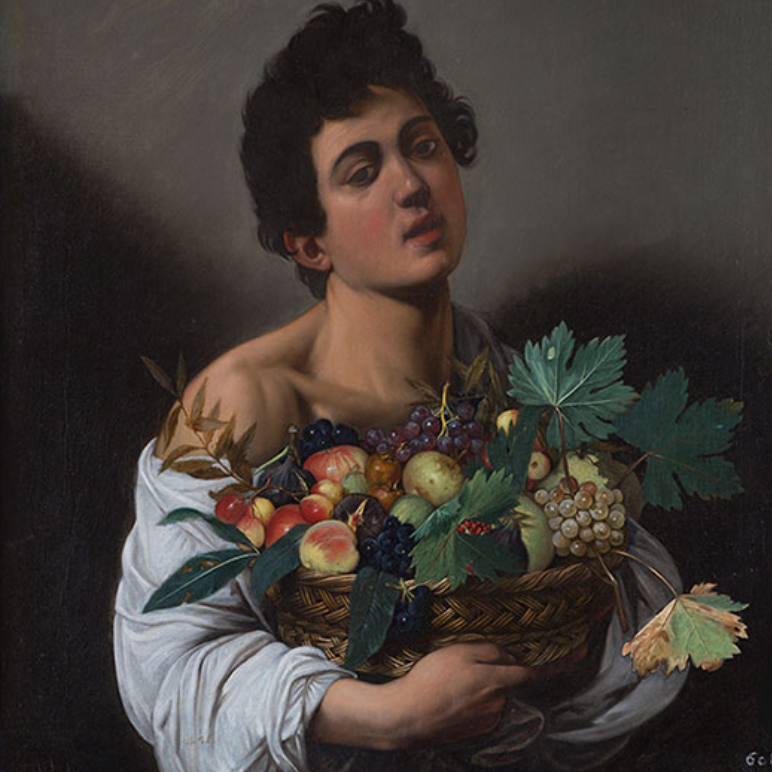
“One takeaway that I learned was that the painter Caravaggio was a brawler and a tough guy who ended up on the run and died at age 39,” said U.S. History teacher Mr. O’Toole. “Most memorably, Boy with a Basket of Fruit captures the ephemeral progression of life, with the fresh, vibrant, colorful fruit on the right-hand side of the painting changing to the aging, rotting remnants on the left.”
To help him acquire this massive collection of artifacts, Morgan employed Belle da Costa Greene to act as both the librarian and the person in charge of using Morgan’s wealth to purchase rare artifacts.
It was Greene who helped diversify Morgan’s collection, going directly to Europe to converse and negotiate with collectors of rare artifacts to persuade them to sell to her.
Greene was also a major factor in bringing the library to the public, transitioning it from a private sanctuary to a public institution with exhibitions that displayed many of the artifacts she purchased.
Another fact about Greene was that she was a Black woman who passed as white. Greene’s lighter skin tone allowed her to pass as a white woman, despite being of African American descent.
Greene’s father was the first Black Harvard graduate, Richard Theodore Greener. After removing the “r” from the end of her last name, Greene lived her entire life keeping that secret from all but her closest confidants.
Whether or not Morgan actually knew of Greene’s African descent is up for debate. Regardless, Morgan respected Greene and viewed her as a close friend. He paid her a salary of $25,000 a year and left her $50,000 in his will in 1913, which today would be $1,642,686.87.
Nobody knew the library better than Greene, which was especially important considering that Morgan had secret passages installed so he could access higher levels of his library. Behind some bookshelves, there is a winding staircase that leads to the next floor, filled with books that Morgan himself may have read.
Today, those carrying out Morgan’s legacy are still trying to follow in his footsteps of acquiring important pieces of art and literature, including a first edition copy of the first Harry Potter and the Philosopher’s Stone, signed by J. K. Rowling.
“I’d definitely recommend going to the museum,” Wittreich said. “If possible, get a tour guide, because they show you much more of the museum than you’d normally see on your own and explain details you might otherwise miss.”
English teacher Mr. DelPiano reaffirmed this notion, saying that his favorite part of the tour was “the interactions between the students and the tour guide, who was really impressed with how engaged the students were and with how much prior knowledge they already had.”
After the tour concluded, the students went down the street to Eataly NYC Flatiron to enjoy some of Italy’s finest baked goods.
The Italian Honors Society and all those who attended the trip would like to give major thanks to the Morgan Library and Museum for allowing them to visit, and thanks to Mr. Loria for organizing it.
For those who want to take a trip to the Morgan Library and Museum, the normal ticket price is $25; however, students with a current ID receive a $12 discount.
Mr. O’Toole put his final thoughts simply: “Anyone thinking about going to the museum should absolutely go!”