






As the Olympics take place, football season comes to a close, and baseball gets ready to begin, the NBA brought its biggest stars out to play on an international level. From February 13th to February 15th, the NBA held its 75th All-Star Game at the Intuit Dome in Inglewood, California.
After multiple individual competitions, including the three-point contest and dunk contest, the weekend was capped off on February 15th with the main event of the weekend: the All-Star Game.
Recently, the All-Star Game has taken some heavy critique from both fans and players. Many believe that decades ago, from the early 2000s and back, the All-Star Game represented a night where the greatest basketball players in the world would get to go head-to-head, conference vs. conference, in an all-out battle to see who was the best.
Many believe that back then, pride was on the line. Players treated the event as something sacred, and something to be taken extremely seriously. Losing was not an option.
Famously, during the 2003 All-Star Game, Michael Jordan (suited up for the Washington Wizards) hit a fadeaway two-pointer that put the East up 138–136 over the West during overtime. Kobe Bryant received the ball for the West, and with one second remaining, Bryant was fouled inside three-point range and now had a chance to either win the game or send it to double overtime.
Eastern Conference coach, former Bad Boy Piston and NBA champion Isiah Thomas told Bryant to miss the free throws in order to let Jordan end his last All-Star Game with a notch in the win column.
Bryant was repulsed by the notion, and he proceeded to hit the first and third free throws, sending the game to double overtime, where the West would eventually get the win over Jordan and the East.
Modern NBA fans argue that the passion players once had is no longer there. The game doesn’t count for overall records, and people simply don’t care about winning anything other than the NBA Finals. What does it matter if the West beats the East, when often only one or two of the players that are a part of these All-Star teams will go on to have their own franchises win it all?
Spurs center, 7’4” Victor Wembanyama, has been a driving force in bringing the passion back. He believes the All-Star Game does mean something, and he has been trying to light a fire under other NBA players.
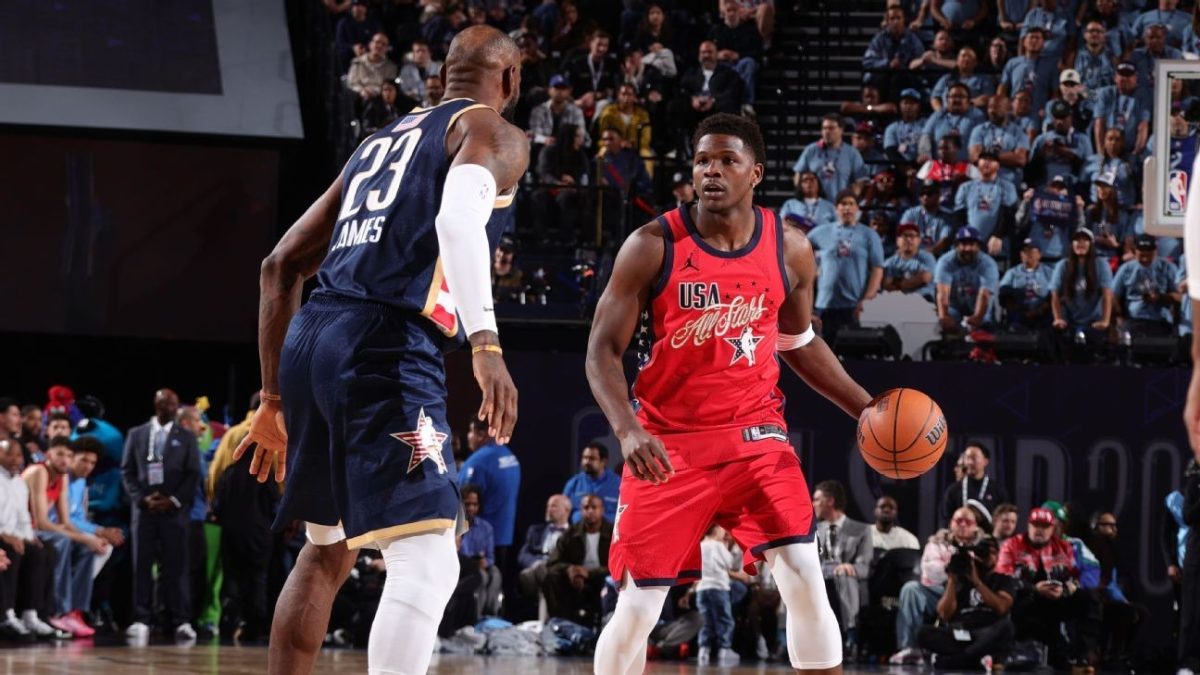
The East vs. West format NBA viewers are accustomed to was thrown out the window for this 75th anniversary game. This year, the All-Star Game broke players into three teams: Team World, Team USA Stripes, and Team USA Stars. Team World consisted of NBA players born outside the U.S., Team USA Stripes consisted of veteran players born within the U.S., and finally, Team USA Stars consisted of rising stars born within the U.S.
Instead of just one four-quarter game, it was now a tournament formatted as a round robin, where each team would face each other at least once in a 12-minute (or one NBA quarter) game. The two teams with the best performances would advance to face each other in a winner-take-all final match.
The first game of the night saw Wembanyama and Team World take on Minnesota Timberwolves star Anthony Edwards and Team USA Stars. Despite being on opposite sides of the court, Edwards has shared Wembanyama’s belief that the All-Star Game has become stale and needs some new life breathed into it.
The players all proved they had renewed passion for the event, as both teams fought valiantly, keeping the game close until the very last second. As the 12-minute regulation ended, the teams found themselves interlocked in a 32–32 tie.
Unlike the regular season, where overtime is an additional five-minute period, the All-Star Game scrapped the time element entirely, rather opting for a simple first-to-score-five-points-wins system.
Edwards got the scoring started with a two-pointer, immediately answered by Wembanyama, who fired off a three to take the lead. Member of Team Stars, Indiana Pacers power forward Pascal Siakam drove into the paint before quickly passing the ball out to Scottie Barnes of the Toronto Raptors, who won the game for the Stars with a three-pointer, making the final score 37–35.
After winning their first match, Team Stars stayed on the court to play Team Stripes in the second match.
Just like the first game, the battle of the U.S.-based stars ended with a high and close score. With 18.8 seconds left, Team Stripes inbounded the ball while down by one.
After Lakers star LeBron James and Suns forward Kevin Durant took turns handling the ball, it ended up in the hands of Spurs point guard De’Aaron Fox, who got off a buzzer-beating three-pointer that careened through the net and won the game for the Stripes, 42–40.
Now it was time for Wembanyama and Team World to return to the court to face Team Stripes.
Just like games one and two, the third game would be an offensive duel. Los Angeles Clippers small forward Kawhi Leonard was not originally chosen as an All-Star for the 2026 season. After a large outcry from NBA fans claiming Leonard was snubbed, NBA commissioner Adam Silver added Leonard as a commissioner’s pick to the Stripes’ roster.
Despite a decent first-game performance against Team Stars, game three would see the L.A. native show why many believed he should have been an All-Star from the jump.
Of Team Stripes’ 48 points in the third game, Leonard scored 31 of them.
Leonard scored six three-pointers, grabbed three rebounds, and recorded two steals, while also being one of only two players to stay on the court for the full 12 minutes during the third game.
Leonard’s performance was so impressive that Liam Charles Antetokounmpo, son of Bucks star and Team World member Giannis Antetokounmpo, was seen on the sidelines giving Kawhi two thumbs up while smiling from ear to ear.
With the game tied 45–45 and under 10 seconds remaining, Leonard found himself matched up against Knicks center Karl-Anthony Towns.
Leonard is no stranger to game-winning shots. Sixers fans still have NBA broadcaster Kevin Harlan’s “Is this the dagger?” ringing in their ears after Leonard’s game-winning shot eliminated them from the playoffs in 2019. Leonard and the Raptors would go on to win the championship that very year.
In a similar position, with the game tied, the worst Leonard could do was miss, the buzzer would sound, and the Stripes would be off to the second overtime of the night.
Leonard sized up the seven-footer guarding him, stepped into two-point range, before stepping back and hitting a game-winning three to send the Stripes to the final match of the night.
While the first three matches of the night were thrilling in all aspects, it seemed like the older Stripes players—who had been on the court for two games straight and were going into a third—had tired themselves out by the final match.
The Stars, driven by anger from their earlier loss to the Stripes, obliterated the vets 47–21. Edwards found himself the recipient of the All-Star MVP award.
Despite a lackluster final game blowout, the 2026 All-Star Game was regarded as one of the best in years. After five format changes in eight years, it seems Adam Silver has found the right recipe to get the fans back into one of the greatest shows of talent in the sports industry. But that’s with big thanks to people like Wembanyama, Edwards, and Leonard, who have taken the All-Star Game back to the heights it was once at many moons ago.