










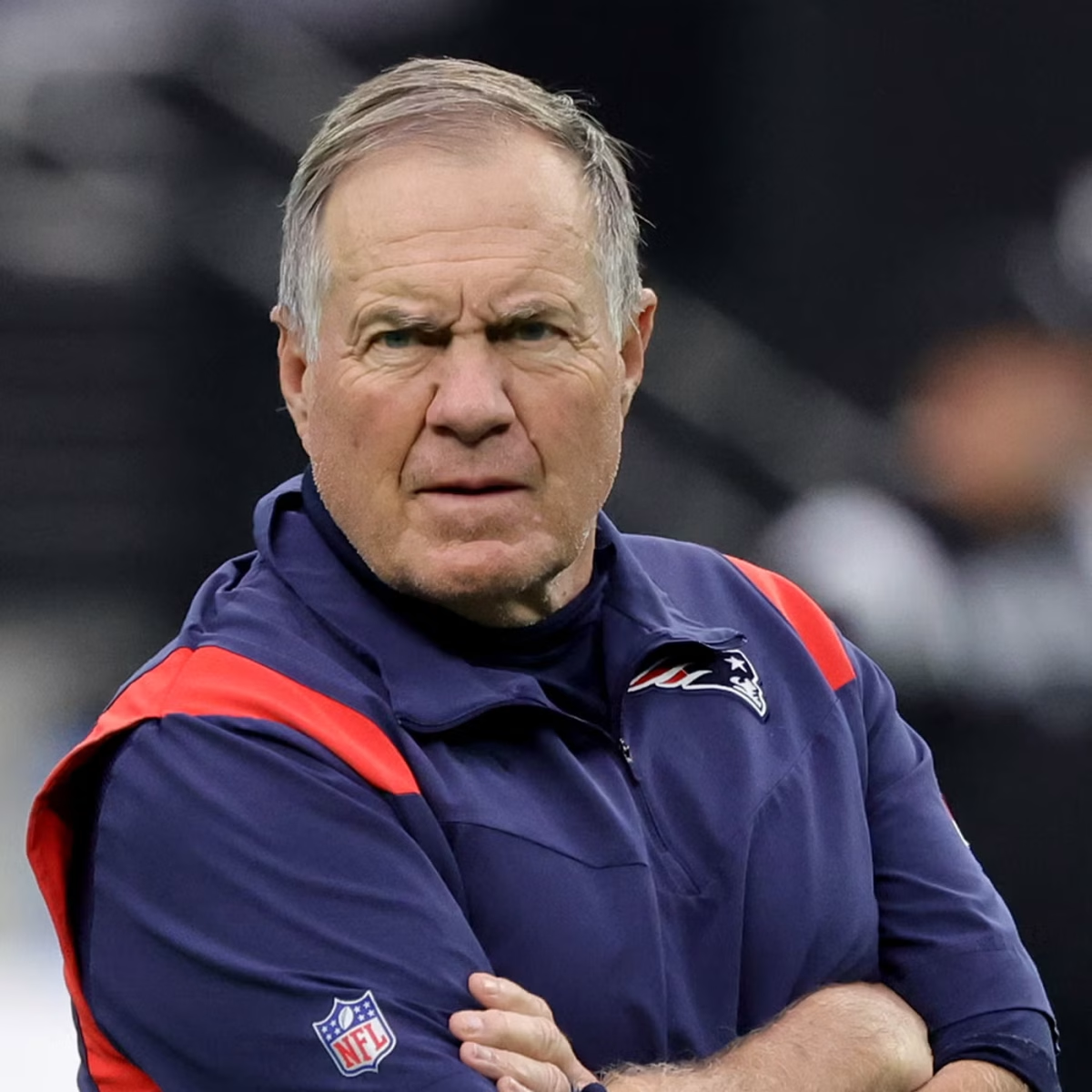
As the Patriots returned to the Super Bowl for the first time since the end of Bill Belichick’s tenure — only to fall to the Seattle Seahawks on the game’s biggest stage — their former head coach remains on the outside looking in.
Let’s cut to the chase. Bill Belichick is an eight-time Super Bowl champion: six as head coach of the New England Patriots (2002, 2004, 2005, 2015, 2017, 2019), and two as the defensive coordinator of the New York Giants (1987, 1991). He is a three-time AP NFL Coach of the Year (2003, 2007, 2010). He holds a litany of records, including most Super Bowl wins, most Super Bowl appearances, most playoff wins as a head coach, and most divisional championships as a head coach.
And yet, despite those accolades, Belichick was not inducted into the Pro Football Hall of Fame.
The 2026 Hall of Fame eligibility class included 128 modern-era players. Some big names included Giants quarterback Eli Manning, Saints quarterback Drew Brees, Patriots kicker Adam Vinatieri, and Panthers linebacker Luke Kuechly. That list of 128 was reduced to 26 semifinalists, and then to 15 finalists. Along with those 15 finalists were five additional candidates: three seniors (players who have been out of the league for 25 years or more), one coach (Belichick himself), and one contributor (Patriots owner Robert Kraft). From that group of 20, between four and eight individuals were expected to be inducted.
Belichick was not one of them.
As a Giants fan, I have nothing to gain from Belichick being inducted. My G-Men handed him two of his three Super Bowl losses with the Patriots, in 2008 and 2012.
But even setting fandom aside, his continued exclusion raises serious questions. If a man with eight Super Bowl rings — six as a head coach, the most in league history — can’t get in, then who deserves to?
To be clear, Belichick is not an uncontroversial eight-ring saint.
In 2007, the Patriots were embroiled in what became known as “Spygate.” The team was caught filming the New York Jets’ defensive signals from the sideline, a direct violation of NFL rules. The punishment included a $500,000 fine to the team and a $250,000 personal fine for Belichick.
In 2015, the franchise faced another scandal: “Deflategate.” The Patriots were accused of using slightly deflated footballs to make them easier to grip and throw. While the league handed quarterback Tom Brady a four-game suspension, fined the organization $1 million, and stripped the team of two first-round picks (in 2016 and 2017), the controversy itself remains debated. The NFL concluded it was “more probable than not” that Brady was aware of the situation, though full testing details were never publicly released.
Fair or not, those incidents are part of Belichick’s legacy.
Beyond the scandals, critics question whether Belichick’s success was inseparable from Tom Brady. With Brady as his quarterback, Belichick posted a remarkable 249–75 record. Without Brady, his record dipped below .500, with 83 wins and 104 losses.
Brady, of course, left New England, joined forces with Rob Gronkowski in Tampa Bay, and captured his seventh and final Super Bowl ring — without Belichick.
To some, that’s the ultimate counterargument: perhaps Belichick without Brady would have been just another coach.
Even off the field, Belichick has remained a lightning rod. The 73-year-old has been dating 24-year-old former competitive cheerleader Jordon Hudson since 2023. The nearly 50-year age gap has drawn public criticism and added another layer of scrutiny to his public image.
All of this — the championships, the controversies, the relationships — is weighed when Hall of Fame voters make their decisions.
To be inducted, a candidate must receive 80% of the vote. Of the 50 voters, at least 11 cast a “no” vote, keeping Belichick out.
Cheating allegations have derailed Hall of Fame cases before. Barry Bonds, MLB’s all-time home run leader with 762, has not been inducted into the Baseball Hall of Fame due to steroid accusations.
The larger question becomes: Should someone who cheated — or was associated with cheating — still be enshrined if their accomplishments are undeniable?
How much greatness can be overshadowed by controversy? And what level of wrongdoing can, or should, be forgiven?
Randy Moss played on the 2007 Patriots during Spygate. Yet voters rightly elected him as a first-ballot Hall of Famer. Being on that team wasn’t enough to taint his individual legacy. So why is it different for the coach?
It is easier, perhaps, to evaluate players. They are the ones on the field. But was Belichick the mastermind who led the Patriots to nine Super Bowls, winning six? Or was it Brady, Gronkowski, Moss, and others who simply happened to be coached by him?
The Patriots’ recent Super Bowl loss to Seattle only complicates the narrative. Their return to the big game without Belichick suggests the franchise can still contend — but their inability to finish the job may also serve as a reminder of just how rare sustained championship dominance truly is.
Maybe Belichick’s exclusion is fueled by decades of resentment toward a man who helmed one of the most dominant dynasties in sports history. Maybe it’s the scandals. Maybe it’s the perception that Brady was the true engine of success. Maybe it’s all of it.
No one is perfect. And Hall of Fame voting is rarely simple.
Many view keeping an eight-time Super Bowl champion out of Canton as blasphemy. Others see it as accountability.
But one thing remains undeniably true: no one has won as much as Bill Belichick. Yet winning as much as he did may have become its own curse. He is scrutinized more heavily, judged more harshly, and debated more intensely than perhaps any figure in modern NFL history.
And after watching the Patriots fall short in their long-awaited Super Bowl return, the question lingers even louder:
If not him, then who?
Still, there’s always next year.